



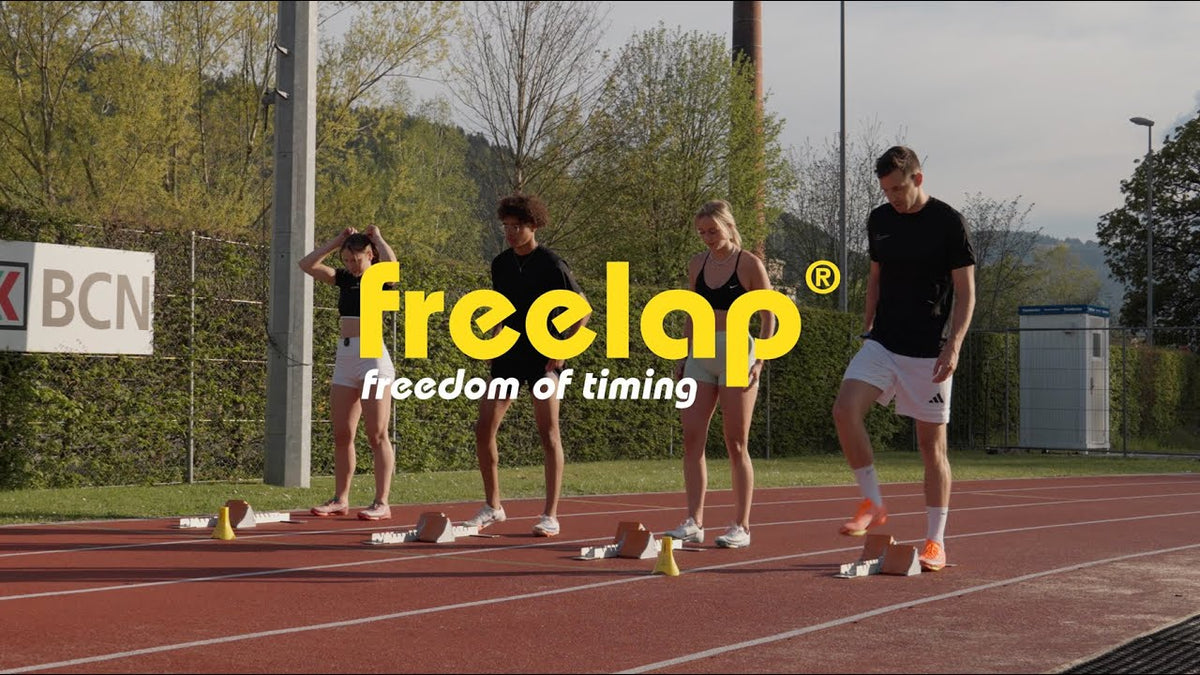
Sprint times are easy to record and easy to misread. A faster time does not always mean the athlete improved. A slower time does not always mean the athlete regressed.
The data is only useful when the test conditions are comparable. Coaches need to control the variables that change the number.
Same distance
This is the first rule. A 10m split must be 10m every time. A flying zone must be measured the same way every time.
If cones, transmitters, or gates move slightly each session, the test becomes less reliable. Distance errors become more visible over short splits because the time window is small.
Same start protocol
Start position affects early acceleration. Compare standing starts to standing starts. Compare three-point starts to three-point starts. Compare rolling starts only to rolling starts.
Changing start protocol changes the test.
Same trigger method
Different timing systems measure different physical events. A beam system may trigger from a limb crossing the beam. A wearable chip system triggers from the chip passing the timing field. Hand timing includes human reaction.
If coaches switch timing methods mid-block, the data may still be useful, but it should not be treated as a clean continuation.
Same surface and direction
Surface affects sprint output. Track, turf, grass, and indoor flooring do not produce identical conditions. Direction matters outdoors if wind or slope is involved.
If the surface changes, record it. If the direction changes, record it.
Same athlete readiness
Timing data should be interpreted with the session context. Times recorded after a full warm-up, during a speed session, and after a fatigue-heavy practice do not represent the same state.
This does not mean fatigued timing is useless. It means it answers a different question.
Same comparison window
Coaches should compare data within the same training context. Examples include best acceleration split this block, average flying split over three exposures, drop-off across repeated sprints, or return-to-play progression by distance.
One isolated time can mislead. A pattern is more useful.
Where Freelap fits
Freelap helps keep timing method consistent across sessions. When the same chip placement, transmitter placement, and test setup are used, coaches can build a cleaner data history.
The system provides the timing measurement. The coach still controls the protocol.
Practical recommendation
Before comparing sprint times, ask: Was the distance the same? Was the start the same? Was the timing method the same? Was the surface comparable? Was the athlete in a similar state?
If the answer is no, interpret the result carefully.
Common Questions:
Why are sprint times different between sessions?
Sprint times can change because of performance, distance, start protocol, timing method, surface, wind, fatigue, or warm-up quality.
Can coaches compare times from different timing systems?
They can review them, but they should not treat them as identical measurements because different systems may use different trigger methods.
What is the best way to compare sprint timing data?
Use the same protocol, same timing method, same distance, and similar session conditions. Compare patterns, not isolated results.


Share:
How to Set Up Sprint Timing for Repeatable Split Data
How Coaches Should Use Sprint Timing Data Without Overreacting