



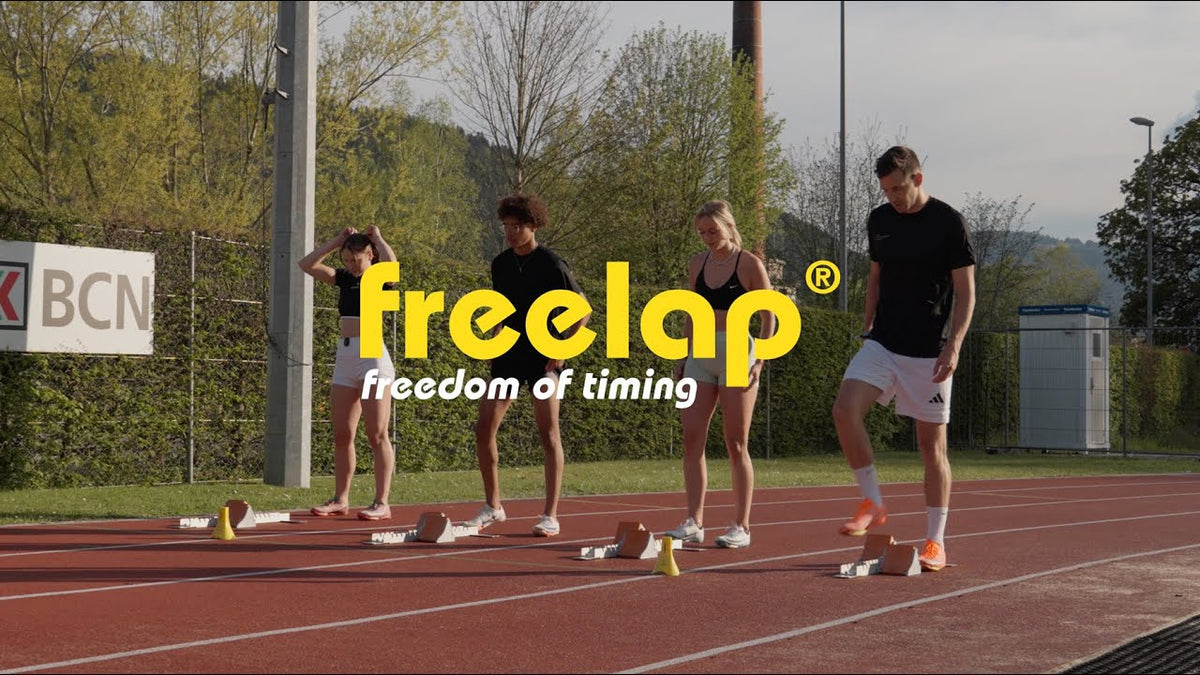
What Data Should Coaches Record During Sprint Testing?
Sprint testing is only useful if the data can be compared later. A single time tells part of the story. A repeatable record tells more.
Coaches need enough information to explain why a result changed, without turning every session into a data-entry task. The goal is not to record everything. The goal is to record the variables that affect interpretation.
The timing result
Start with the time. For sprint testing, that may include 10m split, 20m split, 30m split, flying split, total sprint time, or repeated sprint times.
The exact distances depend on the test. What matters is that the same split structure is used across sessions. Changing from a 10m split to a 15m split may be useful for a different question, but it breaks comparison with previous data.
The test setup
The setup defines the result. Record start type, split distances, transmitter or gate placement, athlete start position, surface, and indoor or outdoor setting.
This is especially important when comparing sprint data over weeks or months. A 0.04 second change may reflect training adaptation. It may also reflect a different start position, trigger point, or surface.
The athlete context
Sprint data should be connected to the athlete, not just the stopwatch. Record athlete name, date, session type, warm-up status, fatigue state if relevant, and footwear if it changes.
This does not need to become complex. Coaches need enough context to avoid false conclusions. A best time recorded after a full warm-up and a slower time recorded after heavy lifting are not the same test condition.
Environmental conditions
Outdoor sprint testing is affected by the environment. Record wind direction if noticeable, temperature if conditions are extreme, surface condition, and lane or testing area.
Coaches do not need a weather station for every session. They need enough information to explain unusual data.
The decision made from the data
This is the part many coaches miss. Record what the data changed.
Examples include keeping an athlete in acceleration work, moving an athlete to max velocity exposure, reducing volume after drop-off, advancing return-to-play progression, or adjusting a technical cue.
Timing data should support coaching decisions. If no decision is attached to the data, the record is incomplete.
Where Freelap fits
Freelap helps simplify the timing portion of the record. Coaches can capture splits through the MyFreelap app and keep timing data connected to the session.
The system does not replace coaching interpretation. It gives coaches objective timing data so the interpretation is based on a consistent measurement source.
Practical recommendation
For most sprint testing sessions, record five things: athlete, test distance and split structure, start protocol, timing result, and coaching decision.
That is enough to make the data useful without slowing the session.
Common Questions:
What sprint testing data should coaches record?
Coaches should record the athlete, test distance, split structure, start protocol, timing result, session context, and any decision made from the result.
Why is sprint testing context important?
Context helps coaches understand whether a change in time reflects performance, setup, fatigue, surface, or environmental conditions.
Should coaches record every sprint rep?
Not always. Coaches should record reps that support a testing goal, training decision, or long-term comparison.

Share:
Electronic Timing System FAQ for Coaches
How to Set Up Sprint Timing for Repeatable Split Data