


The best electronic sports timing system depends on how it will be used.
For sprint training and performance testing, wearable timing systems provide consistent and repeatable split data with minimal setup. For large competitions, RFID chip timing systems are used to manage athlete identification and results at scale. These systems are not interchangeable. They solve different problems.

Types of electronic sports timing systems
Electronic timing systems fall into three main categories.
Wearable timing systems
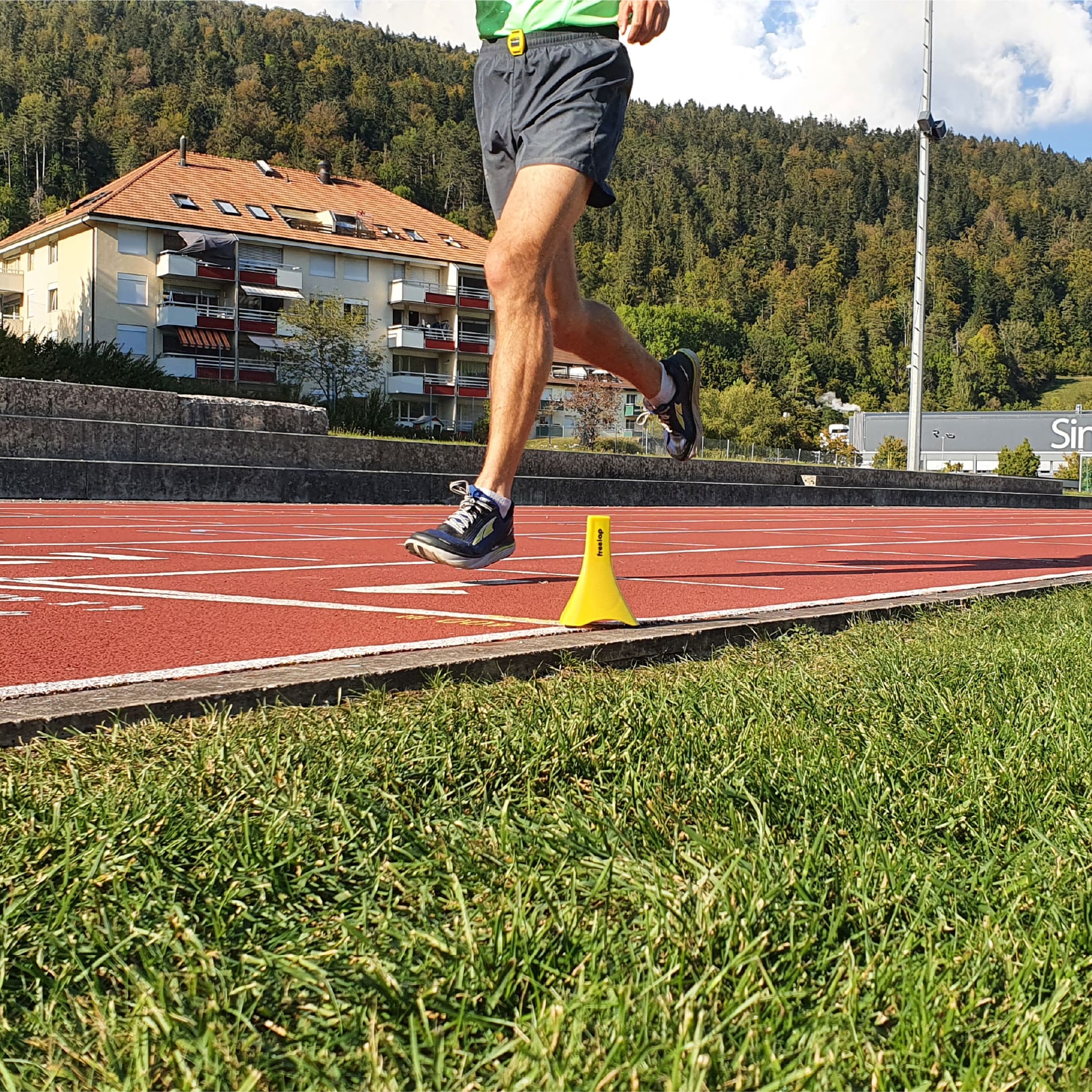
Used for sprint training and performance testing. Athletes carry a transponder and timing is triggered at fixed points. These systems are designed for repeatable measurement across sessions.
Beam timing systems
Use laser or infrared gates. Timing starts and stops when a beam is broken. These systems require alignment and controlled setup.
RFID timing systems
Used in races. Athletes wear a chip that is detected at mats or checkpoints. Designed for large-scale events and automated results.
What matters more than accuracy
Accuracy claims are often based on ideal conditions. In practice, reliability matters more. If a system produces slightly different results each session due to setup changes, the data becomes less useful. Research consistently shows that repeatability is the key factor in performance tracking (Cronin & Templeton, 2011 – https://journals.lww.com/nsca-jscr/fulltext/2011/09000/reliability_and_validity_of_field_sprint_testing.26.aspx).
Training vs competition systems
Training systems are used frequently. They need to be fast to set up and easy to repeat. Competition systems are used less often but must handle large groups and official results.
Trying to use one system for both creates compromise.
Best systems by use case
Track and field training
Wearable timing systems provide consistent sprint splits with minimal setup.
→ See: Best Electronic Sports Timing System for Track and Field
Cycling and lap racing
RFID and loop systems provide consistent lap detection.
→ See: Most Accurate Electronic Timing Systems for Cycling
Cross country and distance training
Training systems measure segments. Race systems measure finish results.
→ See: Freelap vs Cross Country Timing Systems
Triathlon and multi-sport
RFID systems track multiple segments and transitions.
→ See: Best Timing Systems for Triathlon
Collegiate sports
Simple, repeatable systems are used more consistently.
→ See: Best Timing Systems for Post-Secondary School Sports
Mobile app integration
Real-time data improves session quality.
→ See: Timing Systems with Mobile Apps
Road races
RFID systems handle large-scale events and outdoor variability.
→ See: Best Timing Systems for Canadian Road Races
Why coaches choose wearable timing systems for training
Coaches need systems that:
- Work outdoors
- Handle groups
- Require minimal setup
- Produce repeatable splits
Systems that require alignment or constant adjustment are used less often. Lower friction leads to more consistent data collection.
Practical recommendation
Use wearable timing systems for training and performance tracking. Use RFID or fully automated systems for competition. Separate the two roles to maintain both accuracy and consistency.
If you need reliable sprint data in training
Most timing systems are built for events. Training requires something different. Systems that reduce setup and produce repeatable splits tend to be used more consistently.
Explore sprint timing systems for running and track training

Share:
Brower vs SmartSpeed vs Dashr vs Freelap: Which Timing System Fits Which Coach?
Best Electronic Sports Timing System for Track and Field Events